
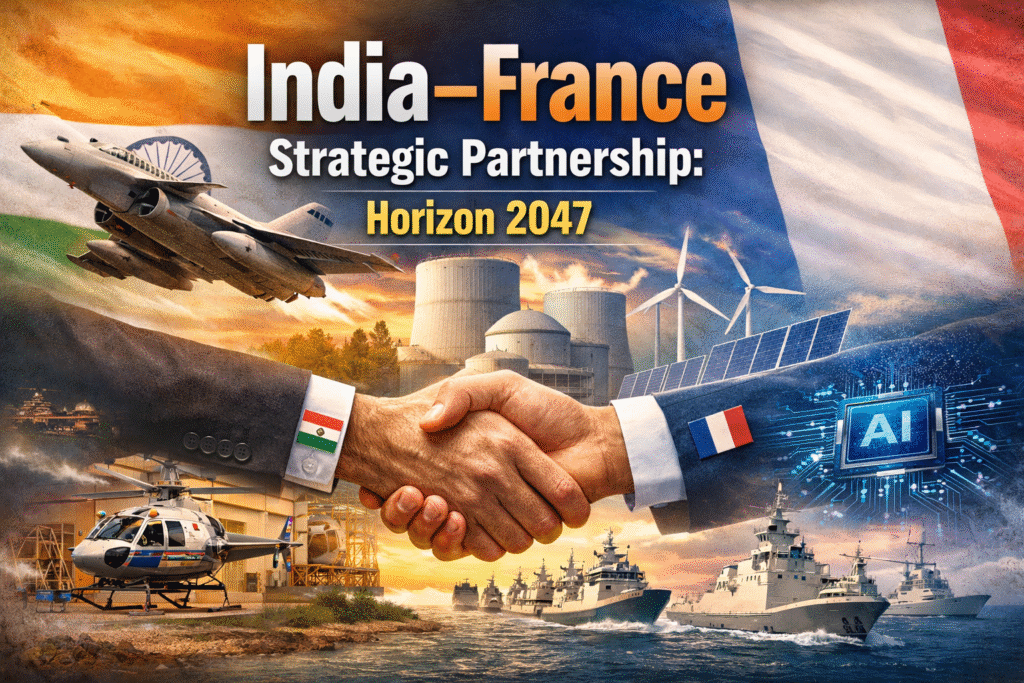
Most people still associate the India-France relationship with the roar of Rafale jets over New Delhi. While those fighter planes and the Scorpene submarines remain the backbone of their military ties, something much larger is happening behind the scenes. In early 2026, the two nations officially transitioned to a Special Global Strategic Partnership. This is not just a change in title. It marks a shift from a basic buyer-seller dynamic to a deep-rooted alliance where both sides treat each other as equals on the world stage.
This new level of cooperation is guided by a document known as Horizon 2047. It acts as a twenty-year plan that looks toward the hundredth anniversary of India’s independence. The goal here is long-term sovereignty. Instead of India simply buying technology from Europe, the two countries are now co-developing it. They are moving away from dependency and toward a shared future where they act as a joint force for stability in a very unpredictable global climate.
A New Era of Joint Innovation
The year 2026 has been named the India-France Year of Innovation for a reason. It is less about fancy ceremonies and more about building a pipeline for new tech. The launch of the India-France Innovation Network is designed to pull together startups and research labs from both sides. A standout achievement in this area is the H125 Final Assembly Line in Karnataka. This is a massive deal because it represents India’s first private sector helicopter plant, run by Tata and Airbus. They are building machines capable of high-altitude missions, intended for the global export market, not just local use.
The Shift Toward Modular Nuclear Power
Nuclear energy has been a quiet but steady part of this friendship for decades. However, the conversation is changing. India has a massive goal of reaching 100 GW of nuclear power by 2047, and the old way of building giant, expensive plants is too slow. The focus has now shifted to Small Modular Reactors (SMRs). These are essentially plug and play versions of nuclear plants that are safer and faster to build.
With the recent SHANTI Act opening up India’s nuclear sector to more private and foreign collaboration, France has stepped in as a primary research partner. They are currently working on standardized designs that can be rolled out across industrial hubs. This helps India meet its clean energy targets without the massive delays that usually plague traditional energy infrastructure projects.
Stability in the Indo-Pacific
It is easy to forget that France is actually a neighbor in the Indian Ocean. Because of territories like Reunion Island, they have a permanent presence in the region, which makes them a natural partner for India when it comes to maritime security. Their cooperation has moved way beyond simple training drills to actual joint naval patrols. Both nations are also putting a lot of weight behind the Blue Economy, which is all about protecting ocean resources and making sure marine biodiversity stays intact for the next generation.
This sea-based bond is especially important right now with all the disruptions in global trade. France has even gone as far as appointing a special envoy to help push the India-Middle East-Europe Economic Corridor (IMEC) forward. They see India as a central pillar for a secure supply chain that connects the East to the West. By working together, they are making sure the Indo-Pacific stays an open space for everyone to trade in, rather than a zone controlled by any single power.
Ethics in the Age of AI
Artificial Intelligence is the newest frontier for this partnership. After the 2025 meetings in Paris, India took the lead by hosting the AI Impact Summit in 2026. What makes this collaboration unique is their focus on frugal AI. They are not just trying to build the biggest, most expensive models; they are trying to create AI that is energy-efficient and affordable for the Global South. From health projects at AIIMS to new digital tools for farmers, they are pushing for a democratic version of technology that puts people over corporate profits.
Building a Human Connection
At the end of the day, high-level treaties are just paper if the people don’t actually connect. The opening of new cultural centers and the move to make visas much easier for Indian students in France show that both governments are playing the long game. They want to create a generation of professionals who are just as comfortable working in Paris as they are in Mumbai.
This relationship has finally grown past the stage of just signing big defense checks. It is now about two sovereign nations deciding to build the future of energy, technology, and security side by side.
