
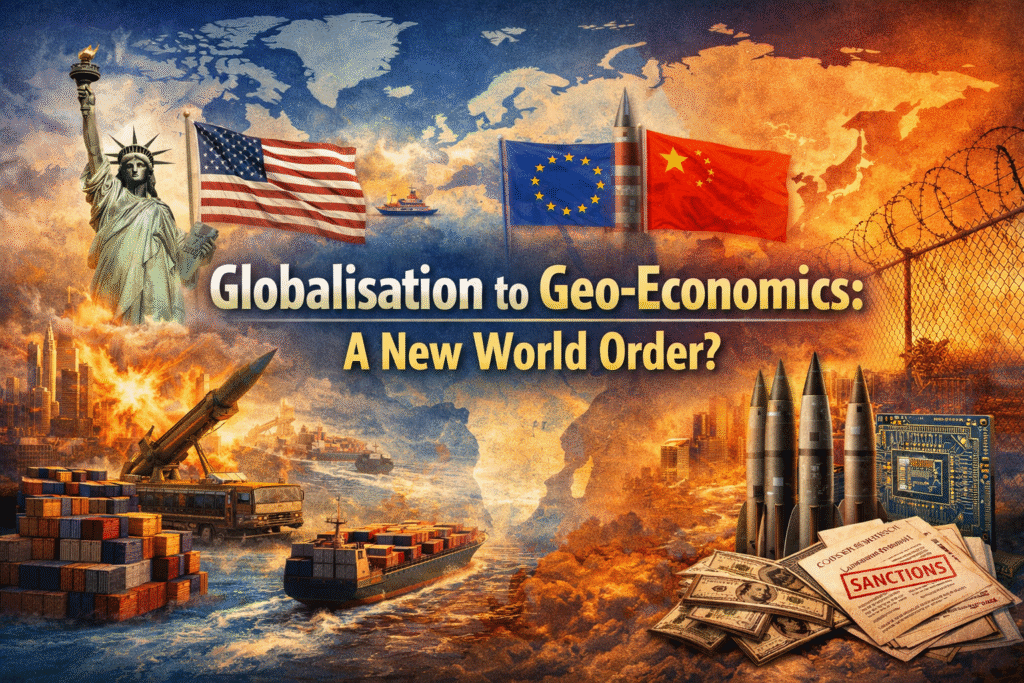
The dream of a frictionless, borderless marketplace has run aground. Since the early 1990s, the global economy operated on the assumption that capital and goods should naturally migrate to wherever they could be handled most efficiently. This was the golden age of globalisation. Today, however, that logic is being dismantled. We are entering a period defined by geo-economics, where economic activity is no longer just a measure of prosperity, but the primary theater for exercising national power.
This transformation is far more than a temporary disruption of trade routes. It represents a fundamental restructuring of how sovereign states perceive their vulnerabilities and their strengths.
From Cost Savings to Strategic Buffers
During the peak of the globalised era, corporations and governments obsessed over cost-optimisation. The goal was to trim every possible cent from a supply chain by relying on just-in-time delivery systems. That model assumed a stable world. Recent shocks have proven that assumption wrong, revealing that a lean supply chain is often a dangerously brittle one.
The focus has now pivoted toward resilience. We are seeing a move away from the cheapest possible source toward friend-shoring and near-shoring. When a nation relies on a geopolitical competitor for 90% of its rare earth elements or advanced semiconductors, it isn’t just a business risk; it is a national security failure. Economic logic is no longer the driver; security logic has taken the steering wheel.
Trade as a Kinetic Tool
The most jarring aspect of the current shift is how interdependence has changed character. In the past, economists argued that deep trade ties would act as a physical deterrent to war. The logic was simple: if we are all making money together, we won’t fight. Today, that same interconnectedness is being utilized as a weapon.
Sanctions, investment blocks, and export bans have become the new front lines. If one country controls the intellectual property for a specific manufacturing process or the physical mines for a critical mineral, that dominance is now treated as leverage. We are watching the construction of digital and physical iron curtains that dictate where data can flow and who can buy the latest hardware.
The Resurrection of the State
For decades, the standard economic advice was for governments to stay out of the way. Picking winners and losers was considered a certain path to inefficiency. Geo-economics has completely inverted this consensus. We are currently witnessing the most aggressive return to industrial policy in nearly a century.
Governments in Washington, Brussels, and Beijing are no longer waiting for the market to decide the future. They are deploying massive subsidies, often reaching hundreds of billions of dollars into domestic sectors like green energy, microchips, and artificial intelligence. This isn’t merely about protecting jobs. It is about technological sovereignty. The belief now is that if a nation does not control its own essential technology stack, it remains at the mercy of those who do.
The Dilemma of Developing Nations
For emerging economies, this shift creates a precarious environment. Under the old rules, the path to wealth was to integrate into global value chains and export products to the highest bidder. In a geo-economic world, these nations are increasingly pressured to pick a side.
Maintaining a position of non-alignment is becoming technically and politically difficult. Many countries that grew wealthy as the factory of the world are now finding themselves trapped between competing subsidy regimes and conflicting trade regulations. The challenge for these states is to become bridge economies that can handle the regulatory requirements of multiple, often hostile, trade blocks simultaneously.
The Decay of Multilateralism
We are not watching the death of trade, but we are certainly seeing the end of a single, unified global rulebook. Institutions like the World Trade Organization are losing their grip as nations increasingly ignore international dispute mechanisms in favor of unilateral actions. These moves are almost always framed as matters of national security, which effectively places them beyond the reach of traditional trade law.
The global marketplace is fracturing into regional spheres of influence. These blocks are likely to operate under entirely different standards for everything from data privacy to carbon emissions, creating a much more complex and expensive environment for international business.
The Reality of a Fractured World
The transition to geo-economics signals a loss of the naive optimism that defined the early 21st century. We have moved from a flat world to a jagged one. While this may increase the cost of goods for the average consumer, policymakers view it as a necessary price for stability and autonomy.
Understanding the balance sheet is no longer enough to navigate the modern world; one must now also understand the map. Risk is no longer a purely financial calculation; it is a geopolitical one.

Pingback: China's Demand Push: What It Means for Indian Manufacturers
Pingback: India Semiconductor Ecosystem: $12B Semicon 2.0 Proposals