
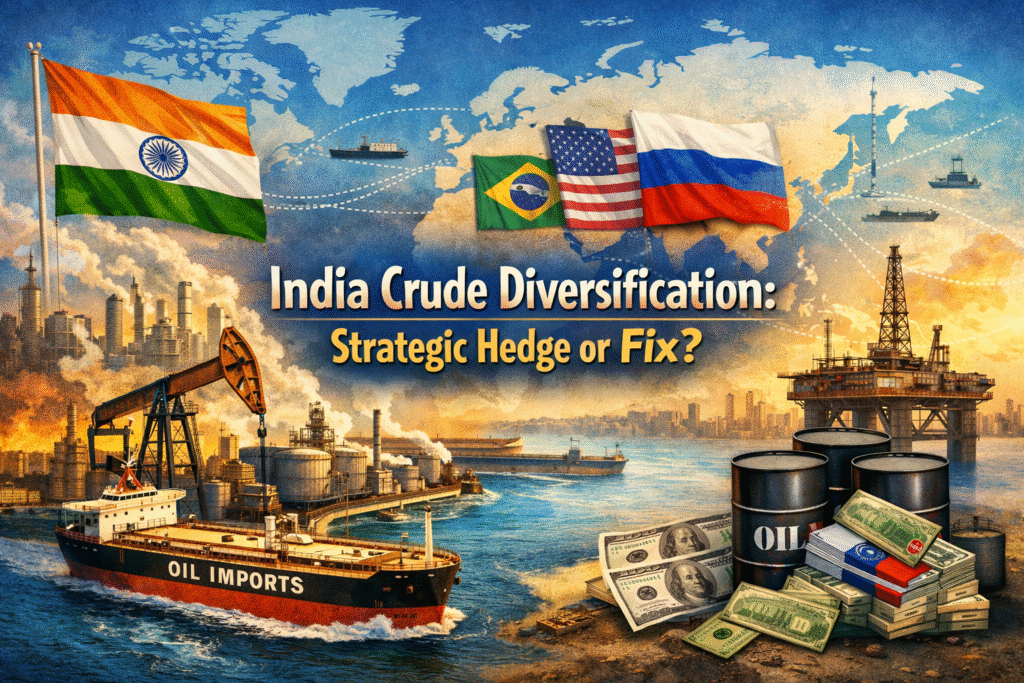
India’s approach to buying oil has changed dramatically over the last couple of years. We used to rely on a very small group of suppliers, mostly in the Middle East, but the world of 2026 looks much more complicated. With the U.S. recently granting a 30-day tariff-free window to process Russian crude, many are asking if India is actually building a long-term safety net or just jumping from one crisis to the next.
As an economist looks at the numbers, it becomes clear that India is trying to solve a massive equation: how to keep energy cheap enough to fuel growth while staying on good terms with global powers.
The 30-Day Waiver: A Tactical Pause
The U.S. Treasury’s decision to allow a one-month window for Indian refiners to unload Russian oil is a fascinating piece of economic theater. From a purely logical standpoint, this isn’t a gift. It is a calculated move to prevent a global supply shock. If India were suddenly forced to stop processing millions of barrels of Russian oil, the global price of Brent crude would likely skyrocket, hurting the American consumer just as much as the Indian one.
For India, this 30-day period is a chance to clear out logistical logjams. It allows ships that were stuck in legal limbo to finally dock and unload. However, relying on these short-term hall passes from Washington highlights a lingering vulnerability. While the oil is flowing today, the long-term certainty of that supply is still tied to someone else’s foreign policy.
Building a Strategic Hedge
Despite the short-term drama, there is evidence of a deeper, more permanent shift. India has expanded its sourcing from under thirty countries to more than forty in just a few years. This is what we call a strategic hedge. By retooling our refineries to handle different types of oil, from the heavy grades found in Russia to the lighter versions from the U.S. and Brazil, India has created a system that can pivot when needed.
This diversification serves two main goals:
- Price Leverage: When you aren’t dependent on just one region, you have the power to negotiate. India has saved billions by capturing discounts that wouldn’t have been available if we were locked into a single supplier.
- Geopolitcal Safety: By bringing in more oil from the Atlantic, India reduces the risk of a total shutdown if a conflict ever closes the major shipping lanes in the Persian Gulf.
The Temporary Fix Problem
While the diversification looks good on paper, it often feels like a series of emergency repairs. The fact that India has to navigate a maze of sanctions and seek specific waivers to keep its economy running suggests that the hedge isn’t fully independent yet.
The reliance on Russian oil is a perfect example. It has fluctuated wildly based on how strictly the U.S. enforces its price caps. This creates a stop-and-go economy for Indian refiners, who have to constantly change their procurement plans based on the latest news from overseas. A true strategic hedge shouldn’t require a monthly check-in with a foreign treasury.
The Hidden Costs of Moving Oil
From a fiscal perspective, buying oil from further away isn’t always a win. Oil from the Middle East is geographically close and cheap to ship. When India buys from the U.S. or Russia, the freight costs go up significantly.
Refiners have to balance the discount they get on the oil against the extra cost of the journey. If the discount disappears but the freight stays high, the economic benefit of diversification vanishes. This makes the current strategy feel more like a survival tactic than a permanent cost-saving measure.
Future Sovereignty: The Real Test
The real question for India’s energy future is whether we can move beyond being a taker of global rules. The current reliance on 30-day windows and tariff exemptions is a sign of a nation still finding its footing.
The final stage of this transition will be when India can settle these trades in its own currency or through its own financial systems, bypassing the reach of external sanctions entirely. Until then, the current strategy is a bit of both: a brilliant short-term fix that is slowly, painfully turning into a long-term strategic shield.
