
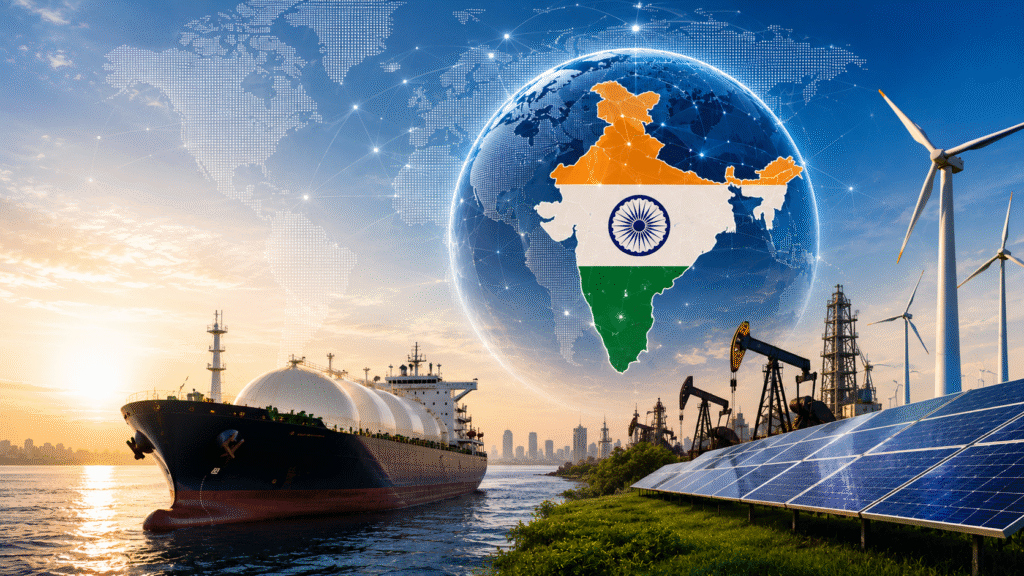
Not very long ago, energy was discussed largely in operational terms. Businesses worried about procurement costs. Governments worried about supply continuity. Beyond that, energy rarely entered mainstream economic thinking unless prices spiked dramatically. That is no longer the case.
The importance of energy in the economy in 2026 is more extensive than we can think. According to the statistics by the Ministry of Petroleum and Natural Gas and IEA, India depends upon 85-88% of the imported crude oil for its requirement. In the past, such numbers would probably sound like any ordinary statistic. However, with all the uncertainties prevailing in the world, their significance becomes even greater now.
The old assumption was that global energy markets, despite periodic shocks, would eventually stabilise around commercial logic. What we are seeing now is something more complicated.
Oil flows are increasingly influenced by strategic alignments, sanctions, production discipline from OPEC+, currency pressures, and geopolitical calculations that extend far beyond economics. The IMF recently pointed to energy volatility as one of the continuing external risks facing import-dependent economies in 2026.
For India, these shifts do not remain abstract for very long
When global crude prices move sharply, the effects are felt across transport networks, industrial pricing, logistics operations, and inflation management. Manufacturers begin recalculating costs. Airlines reassess margins. Infrastructure projects feel pressure through material and freight expenses. What appears international on paper becomes deeply domestic within weeks. That compression between global disruption and local impact is perhaps the biggest change of all.
India’s Approach Is Becoming More Flexible and Strategic
One thing that stands out today is how much more pragmatic India’s energy strategy has become. Over the last few years, sourcing patterns have diversified considerably. According to Petroleum Planning and Analysis Cell (PPAC) data, India now procures crude from a wider set of regions, including the Middle East, Russia, the United States, and African suppliers. The intention behind this diversification is fairly clear: reduce overdependence and retain negotiating flexibility.
This is not really about ideology. It is about protecting economic room for manoeuvre in an increasingly unpredictable world. Because volatility is no longer behaving like a short-term event. It is starting to look structural.
Markets today respond not only to actual supply shortages, but also to expectations, political signalling, sanctions risk, and future production guidance. In several instances over the last two years, crude benchmarks have moved sharply even before any real supply disruption took place.
That changes how countries like India have to think. The challenge is no longer simply securing energy. The challenge is managing uncertainty without allowing it to spread too aggressively through the economy. This is where energy diplomacy begins to matter in a very practical sense.
The ability to maintain multiple supplier relationships, negotiate strategically, secure long-term agreements, and avoid excessive concentration risk now contributes directly to macroeconomic stability. Diplomacy, in that sense, is no longer separate from economics. It is helping shape the conditions under which the economy functions. And in periods of volatility, that flexibility becomes valuable.
The Renewable Shift Is Gradually Expanding India’s Options
At the same time, another transition is slowly changing India’s position in the global energy landscape. Renewable energy is often spoken about as a future ambition, but its impact is already becoming visible in smaller, measurable ways.
As per the Ministry of New and Renewable Energy, India’s solar energy installations reached the 100 gigawatt mark in early 2026. The increase in utility-scale adoption in rooftop installations and investment in transmission infrastructure has consistently improved renewable energy generation capacity in various states.
Electric mobility in India is now moving out of its experimental stage. According to industry reports from SMEV, adoption of electric vehicles will continue to grow in the future, particularly for two-wheelers, commercial use, and fleet vehicles.
These developments do not remove India’s dependence on conventional energy overnight. That expectation would be unrealistic. But they do something equally important: they expand strategic choice. Even incremental reductions in import dependence improve resilience over time. Domestic renewable capability gives countries more flexibility during periods of external disruption. It also changes how they engage internationally.
Closing thoughts
Energy diplomacy now is no longer solely related to crude oil agreements or LNG deliveries. Energy diplomacy now involves technology cooperation, battery value chains, green hydrogen projects, supply chain locations, and industrial competitiveness related to clean energy systems.
That broader shift deserves more attention than it usually receives. Because over the next decade, economic influence may depend not only on manufacturing scale or market size, but also on how effectively countries manage energy security alongside transition economics.
India is still in the middle of that journey. But the direction is becoming clearer.
Energy diplomacy is no longer functioning quietly in the background of economic policy. It is steadily becoming one of the forces shaping the economy itself. And that reality is likely to matter far more in the coming years than many people currently expect.

Pingback: Oil Shock 2.0: Is India Prepared for Rising Crude Prices?
Pingback: Rupee Near ₹96: Should Indian CEOs Rethink 2026 Plans?