
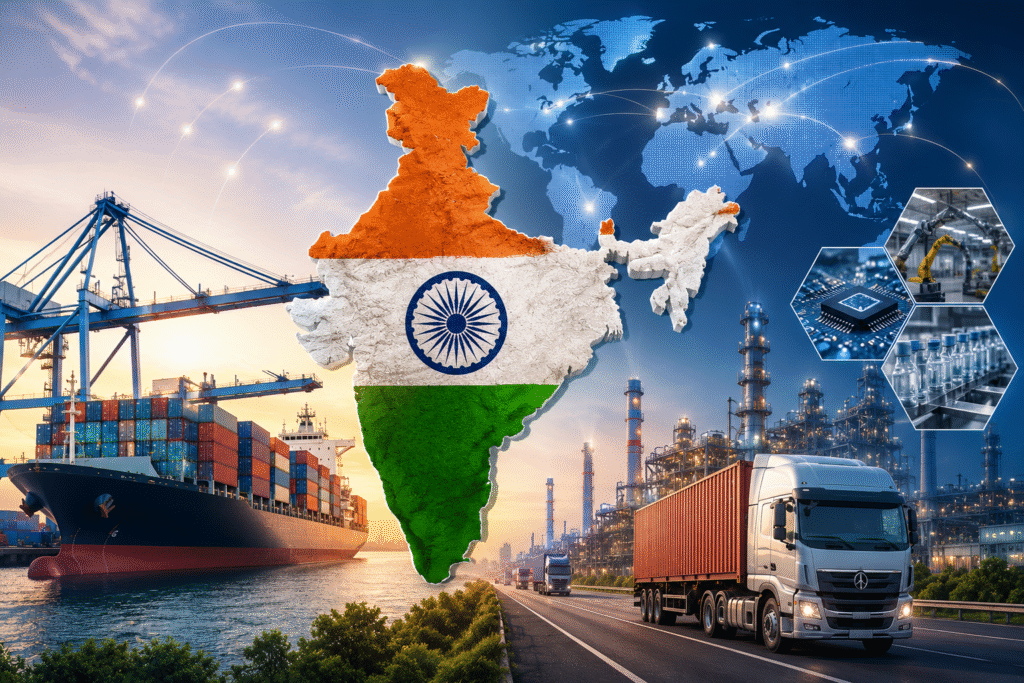
For years, global supply chains were built around a fairly simple assumption: efficiency would outweigh almost everything else. If we take manufacturing to a faster, cheaper, and scalable pace, production would naturally be concentrated in a few geographic locations. This would have been very effective in the past. However, I believe 2026 marks a subtle yet important turning point.
Based on the results of several studies on international trade and foreign investment, multinational corporations continue to expand their geographic exposure in manufacturing production, rather than concentrating too heavily on a single geographic location. It is interesting to note that China continues to contribute around 30% to total world manufacturing production, yet many major organizations are beginning to doubt the risks associated with it.
That shift is changing the tone of global boardroom conversations
The question is no longer just, “Where can we produce most efficiently?” Increasingly, it is also, “Where can we continue operating reliably when the external environment becomes unpredictable?” And I believe that distinction matters far more than many realise.
Globalization is not at an end point here. The trade routes are highly connected, and it is impossible for any country to insulate itself from the worldwide system. However, the model of globalization itself is undergoing changes. Factors like resilience, diversification, reliability of logistics, and geopolitics are now playing a role along with cost optimization. In this new era, India is no longer seen as an outsider to the whole process. Gradually, it is becoming part of the discussion on designing new supply chains in the future.
Efficiency Still Matters, But It Is No Longer the Only Constraint
The earlier global system wasn’t flawed; it was internally consistent. The concentration of manufacturing in a few geographies created enormous productivity gains. East and Southeast Asia became central nodes because they delivered both cost and scale with remarkable consistency. But the same structure also created dependency, with China accounting for nearly 30% of global manufacturing output, and East & Southeast Asia together contributing more than half of global manufacturing exports.
And that dependency has been tested repeatedly over the last few years. The pandemic was just the first warning sign. After that came semiconductor shortages and shipping delays that disrupted global supply chains. More recently, rising geopolitical tensions have made sourcing products even more complex and unpredictable than before.
I do not believe this dismantles globalisation altogether. That would be an oversimplification. What it does change, however, is the way companies define risk. Supply chain resilience is no longer a secondary discussion happening alongside operations. By 2026, it will have become central to operations themselves.
India’s Position Is Real, But Still Being Earned
India is part of this reconfiguration, but I believe it is important not to overstate the position prematurely. There are clear structural advantages. Domestic demand is large enough to support manufacturing scale. Labour availability remains favourable over the long term. Policy direction has also shown more continuity than in earlier economic cycles. There are measurable improvements, too.
Logistics costs, which were long considered one of India’s structural disadvantages, have improved meaningfully. As reflected in the Economic Survey 2025–26, estimates now place India’s logistics costs in the 7–8% of GDP range. That is a significant improvement from earlier double-digit estimates and reflects sustained investment in infrastructure, freight corridors, and transport digitisation.
But I believe global supply chains judge systems less by headline improvements and more by consistency of execution. Some parts of India’s industrial ecosystem now operate with global competitiveness. Others still face friction that international supply chains notice immediately. And in globally integrated manufacturing systems, inconsistency often becomes more visible than progress itself.
Manufacturing Momentum Exists, But Global Buyers Don’t Reward Occasional Strength
Real progress is clearly happening in manufacturing, especially across electronics, pharmaceuticals, and automotive components. Incentive schemes have helped expand capacity, and global companies are actively looking to diversify their supplier base. But procurement doesn’t really run on success stories. It runs on consistency. What matters most is whether a supplier can deliver the same quality, at the same cost, again and again, without surprises.
This is where the conversation becomes more demanding. The question global buyers increasingly ask is not whether a country can produce competitively once. It is whether it can deliver the same quality, within the same timelines, across multiple production cycles without disruption. That is a much higher benchmark than simply adding capacity. And it is also where India’s long-term credibility will ultimately be tested.
The External Environment Is Not Stabilising Either
It would be easier if the global environment itself were becoming more stable. It is not. Energy markets remain volatile. Shipping routes continue to experience periodic disruptions. Trade relationships are increasingly influenced by strategic alignment rather than purely economic logic.
Recent assessments from institutions like UNCTAD continue to show that investment decisions are now being shaped as much by geopolitical insulation as by labour cost advantages. This fundamentally changes what competitiveness means in the modern economy. Predictability itself has become an economic advantage.
The Real Question Is No Longer Entry, It Is Staying Power
At this point, India is clearly inside the global supply chain conversation. That is no longer the uncertain part. The more important question, in my view, is whether India can sustain that relevance consistently over time rather than episodically during moments of disruption.
Because global supply chains are no longer searching only for the cheapest manufacturing destination. Increasingly, they are searching for dependable systems that remain functional under pressure. That standard cannot be achieved through announcements alone. It requires execution that is repeatable across years, sectors, and economic cycles.
Closing Thought
I believe the reshaping of global supply chains doesn’t really feel like a short-term phase anymore. It seems to signal a deeper shift, where companies are starting to value resilience just as much as efficiency when building and managing their networks. For India, this creates a serious opportunity, but also a serious responsibility. The country already possesses many of the structural ingredients required to become a larger part of global manufacturing networks.
The real challenge now is turning these strengths into lasting operational trust. That shift has already begun, though it’s still uneven in parts. If execution keeps improving steadily and consistency becomes the norm, India won’t just take part in the next phase of global trade realignment. It could gradually become one of the countries that helps shape how stronger, more resilient global supply chains are built going forward.

Pingback: India Manufacturing Growth Hits Five-Year Low: Warning or Pause?
Pingback: China's Demand Push: What It Means for Indian Manufacturers