
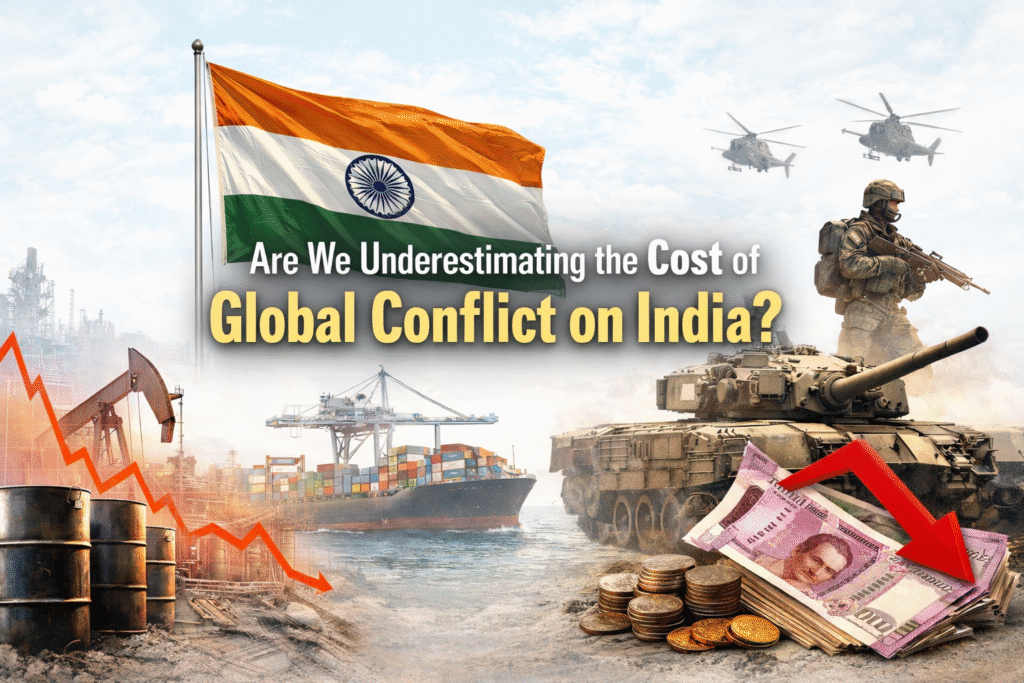
There is a tendency, particularly in emerging economies like India, to view global conflict as something that sits outside the core economic model. We acknowledge it in passing, factor it into risk reports, and then return to more controllable variables such as domestic demand, policy levers, and sectoral growth.
But that separation is becoming increasingly difficult to defend. India is not operating in a domestic vacuum anymore. We are embedded deeply in energy markets, capital flows, and supply chains that are directly shaped by geopolitical stress. The cost of that exposure is rising in ways that are not always immediately apparent in quarterly data.
Energy shocks are now transmission mechanisms
One of the clearest channels remains energy. As of 2026, India continues to import close to 85–90% of its crude oil requirement. This single dependency quietly amplifies almost every external shock.
When tensions escalate in key corridors such as West Asia, the impact is not theoretical. It shows up in freight costs, insurance premiums, refinery margins, and ultimately retail inflation.
A sustained spike in crude prices has the capacity to shave off growth momentum quite quickly by around half a percentage point or more in stressed scenarios. What matters here is not just the magnitude of the shock, but the speed of transmission.
Inflation is behaving differently than before
Inflation today is less cyclical and more externally imported than many models assume. Energy and food prices are particularly sensitive to geopolitical events, and that sensitivity has increased.
Recent 2026 estimates suggest that prolonged instability in key supply regions could push inflation closer to the upper end of the 4.5–5% range. That may not sound dramatic in isolation, but for households already dealing with cumulative price pressure, it changes behaviour quite quickly. Consumption softens. Pricing power becomes uneven. And businesses start planning defensively rather than ambitiously.
Capital flows react before fundamentals do
There is another layer that is often underestimated: sentiment-driven capital movement. Foreign investors do not wait for domestic indicators to weaken before adjusting exposure. They respond to global risk cues, sometimes abruptly. In recent months, emerging markets have already seen episodic outflows as global uncertainty rises, even when individual country fundamentals remain stable. India is not exempt from this pattern. The result is often visible in currency pressure and tighter domestic liquidity conditions, even when policy rates remain unchanged.
Fiscal trade-offs become sharper
Conflict also has a quieter but very real fiscal consequence. Governments are forced into balancing immediate stability with long-term investment. Energy support, defence allocation, supply-side interventions, these are necessary responses. But they inevitably compress fiscal headroom for infrastructure, education, and productivity-enhancing expenditure. The trade-off is not always acknowledged explicitly, but it is always present.
Supply chains no longer behave predictably
It is also important to recognise how fragmented global logistics has become. Conflict does not need to directly involve India to affect the Indian industry. Shipping routes shift. Insurance costs adjust. Critical inputs become delayed or more expensive. For sectors like electronics, engineering goods, and specialty chemicals, this introduces variability that is difficult to hedge fully. And markets do not price uncertainty generously over long periods.
A more fragmented global structure is emerging
Perhaps the most important shift is structural. The global economy is gradually moving away from integrated efficiency towards segmented resilience. Trade is becoming more conditional. Technology access is more regulated. Capital is more selective. India is relatively well-positioned in this transition, but it would be complacent to assume that positioning alone eliminates cost. Adaptation itself carries cost, compliance, diversification, and redundancy in supply chains.
Growth will continue, but not unchanged
The more relevant question is the quality and efficiency of growth in an environment shaped by persistent external volatility. Global conflict is no longer episodic; it is a continuing influence on inflation, capital flows, and policy decisions.
At the same time, India carries clear structural strengths. A large domestic market, steady infrastructure build-out, and a sharper focus on manufacturing provide stability. As global supply chains shift, India has the opportunity to position itself more firmly. With careful execution and measured policy choices, these disruptions can be managed while still sustaining long-term momentum.

Pingback: India’s $5 Trillion Economy by FY29: What Will Drive Growth?
Pingback: Can India Replace China as the World’s Factory?
Pingback: Oil Shock 2.0: Is India Prepared for Rising Crude Prices?
Pingback: Why Energy Diplomacy Will Shape India’s Economy in 2026