
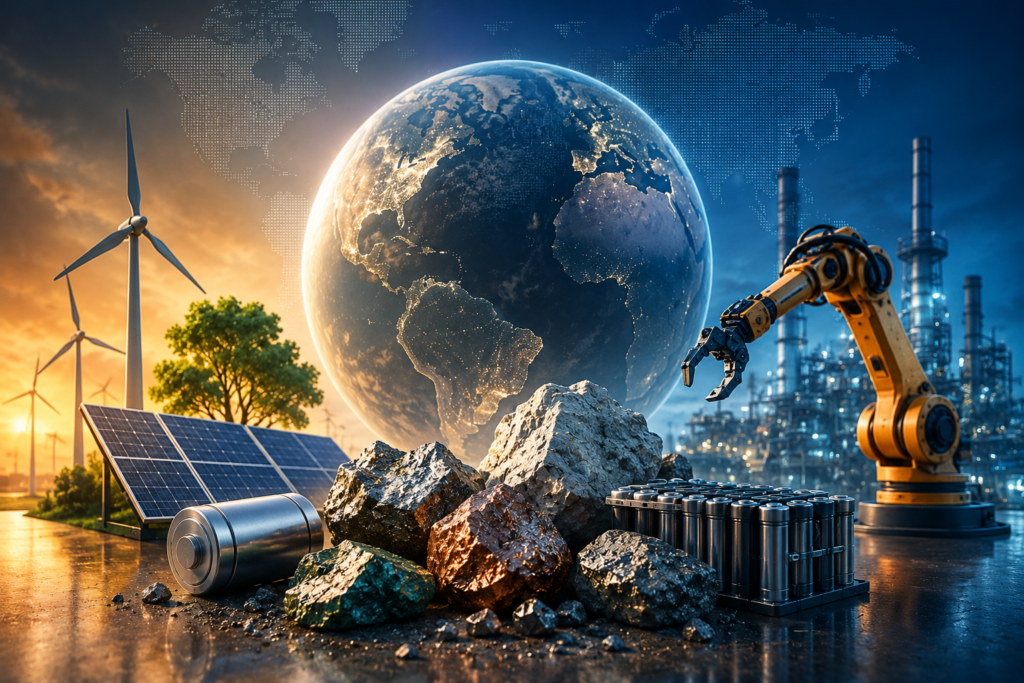
The world’s largest economies are spending billions to build battery plants, semiconductor facilities, renewable energy infrastructure, and advanced manufacturing hubs. Yet many of them are worried about something much simpler.
Will they have enough raw materials to keep those factories running?
That question would have sounded unusual ten years ago. Today, it sits at the centre of economic strategy.
Lithium mines in Argentina, nickel projects in Indonesia, rare earth processing facilities in China, and copper reserves across Latin America are attracting attention that was once reserved for major technology companies.
Governments are sending trade delegations, signing long-term agreements, and investing in overseas assets because they understand something important: industrial strength now depends on resources that most consumers never see.
In my view, we are witnessing a shift that will influence global manufacturing for decades.
A New Dimension of Industrial Competitiveness
The discussion around industrial competitiveness has changed dramatically. Earlier, countries competed on labour costs, market size, logistics, and technology. Those factors still matter. However, another layer has quietly entered the equation. Access to critical minerals is becoming a strategic advantage in its own right.
Recent events illustrate this clearly.
The European Union has accelerated efforts to diversify supplies through its Critical Raw Materials strategy. The United States continues to invest heavily in domestic battery and mineral supply chains.
Japan and South Korea are strengthening partnerships with resource-rich nations to reduce future vulnerabilities. Australia, meanwhile, is moving beyond mining and investing in refining capacity so that more value remains within its borders.
These are not isolated policy decisions. They are responses to a common concern.
A significant share of global mineral processing remains concentrated in a limited number of locations. As geopolitical tensions have increased, governments have become increasingly uncomfortable with relying on supply chains that may be vulnerable to disruption.
Why Manufacturing Is the Real Prize?
What makes this moment particularly interesting is that the competition extends far beyond mining.
The real prize is manufacturing. A tonne of lithium has value. A battery built from that lithium creates far more value. An electric vehicle powered by that battery creates even more. Countries increasingly want a presence across the entire chain rather than at only one stage of it.
India’s Opportunity in the New Industrial Landscape
India’s position deserves attention in this context. The country is simultaneously expanding renewable energy capacity, strengthening defence manufacturing, encouraging semiconductor investments, and supporting electric mobility adoption. Every one of these ambitions depends on reliable access to critical minerals.
The scale of India’s industrial ambitions is already becoming visible. By March 2026, India’s renewable energy capacity had reached nearly 275 GW, making it the world’s third-largest renewable energy market.
At the same time, the government had approved semiconductor projects worth around ₹1.6 lakh crore under the India Semiconductor Mission. Both sectors will require secure and resilient supplies of critical minerals ranging from lithium and cobalt to rare earth elements.
India has already begun taking steps through overseas partnerships, exploration initiatives, and strategic investments. Yet the larger opportunity lies elsewhere. The real opportunity is to build capabilities in refining, advanced materials, battery ecosystems, and high-value manufacturing. History consistently shows that nations create lasting prosperity when they move up the value chain rather than remaining suppliers of raw resources.
That is why I believe the critical minerals conversation should not be viewed through the lens of scarcity alone. It should also be viewed through the lens of industrial opportunity.
From Resource Security to Industrial Leadership
Every major industrial transformation creates new winners. In the nineteenth century it was coal and steel. In the twentieth century it was oil and manufacturing scale. In the twenty-first century, critical minerals are emerging as one of the foundations upon which future industrial leadership will be built.
The competition is real, and the stakes are high. Yet I remain optimistic.
India possesses the market scale, entrepreneurial energy, engineering talent, and policy momentum required to participate meaningfully in this transformation. If the country combines resource security with manufacturing capability and innovation, it can do far more than meet domestic demand. It can become an important contributor to the next generation of global industrial growth.
