
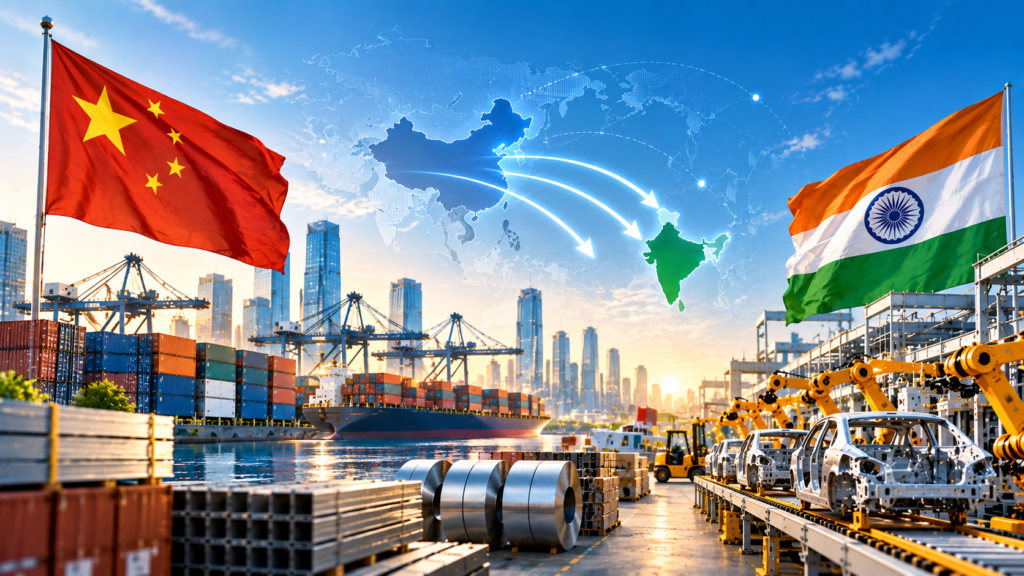
For years, the standard assumption about China was fairly straightforward: when the Chinese economy slowed, Beijing would find a way to get growth moving again.
That assumption is being tested.
China’s latest numbers show an economy that is still producing, but struggling to get its own consumers and businesses to spend. In July, industrial output grew 4.5% year-on-year, down from 5.3% in June. Retail sales grew just 0.6%, while fixed-asset investment fell 6.7% in the first seven months of 2026.
Beijing is responding. This week, Chinese officials said fiscal policy would put greater emphasis on households and domestic consumption, while additional fiscal-financial measures are being prepared for the second half of the year.
At first glance, this looks like a Chinese economic story.
For Indian manufacturers, it is much closer to home.
Because what happens when the world’s manufacturing powerhouse continues to produce faster than its domestic market can consume has consequences for pricing, exports, supply chains and competition everywhere else.
And India is particularly exposed.
China’s problem is not that its factories have stopped producing
That distinction is important.
China is not experiencing a simple manufacturing collapse. Its industrial base remains formidable, particularly in advanced manufacturing, electronics, clean energy and technology.
The imbalance is between production and domestic demand.
Chinese consumers remain cautious, the property downturn continues to weigh on confidence, and private investment has been weak. Yet manufacturing capacity remains substantial. July exports were strong even while domestic indicators disappointed.
When an economy produces more than its domestic market can comfortably absorb, there are essentially two options.
Stimulate domestic demand so more of that production is consumed at home.
Or sell more of it abroad.
China is clearly trying to achieve the first.
But if that recovery takes time, the second becomes increasingly important.
That is where Indian manufacturers need to pay attention.
Weak Chinese consumption can become stronger Chinese competition abroad
There is a temptation to look at a slowing China and assume it creates an automatic opportunity for India.
The reality is more complicated.
A weaker Chinese domestic market can encourage manufacturers to compete more aggressively in overseas markets. And when companies have large factories, established supply chains and excess capacity, price becomes a powerful weapon.
We have already seen international concern around Chinese manufacturing capacity in sectors such as solar equipment, electric vehicles and steel.
The underlying economic logic extends much further.
Machinery. Chemicals. Electronics. Components. Industrial equipment. Consumer products.
If Chinese producers need external markets to compensate for weaker demand at home, Indian companies may find themselves competing against aggressively priced imports not only overseas, but in their own domestic market.
That is why China successfully restarting consumption could, paradoxically, be better news for some Indian manufacturers than a prolonged Chinese slowdown.
A stronger Chinese consumer absorbs more Chinese production.
A weaker one can send that production looking for customers elsewhere.
India’s dependence on Chinese inputs complicates the picture
There is another reason this cannot be treated simply as China versus India.
Indian manufacturing and Chinese manufacturing are deeply connected.
India’s trade deficit with China reached a record roughly $112 billion in FY2025–26. More importantly, much of what India buys is not finished consumer merchandise.
It is what Indian factories use to manufacture other things.
According to an analysis by the Global Trade Research Initiative, around 66% of India’s imports from China are concentrated in electronics, machinery, computers and organic chemicals. China accounts for substantial shares of India’s imports in each of these categories.
So cheaper Chinese industrial goods create a strange situation for Indian manufacturing.
For a domestic producer competing with those imports, lower Chinese prices are a threat.
For an Indian manufacturer buying Chinese machinery or components, they can lower costs.
The same development can therefore help one Indian business while hurting another.
This is why the discussion around China cannot be reduced to whether imports are “good” or “bad”.
The more useful question is: where in the value chain does India want to compete, and where does it remain strategically dependent?
Price cannot be India’s only answer
If Chinese manufacturers become more aggressive internationally, trying to beat them purely on price will be difficult.
China has spent decades building manufacturing clusters, logistics infrastructure, supplier networks and production scale.
India has made substantial progress, but there are still areas where the ecosystem needs to deepen.
That means the competitive conversation has to move beyond labour costs.
Reliability matters. Quality matters. Speed matters. Technology matters. Energy costs matter. Logistics matter. Supplier depth matters.
And increasingly, geopolitical reliability matters too.
Global companies are already trying to diversify parts of their supply chains. India has benefited from that shift in areas such as electronics manufacturing, but the opportunity is not guaranteed.
Companies will not move production to India simply because they want less dependence on China.
They will move when India offers a competitive alternative.
That difference matters.
This could accelerate India’s localisation push
There is already recognition of the vulnerability.
India has renewed efforts to reduce dependence on imported goods across strategically important industries. A recent government push has reportedly identified around $51 billion of imports that could potentially be replaced through greater domestic production, while semiconductor and electronics manufacturing continue to receive significant policy support.
The objective should not be isolation from China. That would be neither realistic nor necessarily desirable.
The objective should be reducing critical dependence.
There is a difference between importing a component because China is the most competitive supplier and importing it because India has no meaningful alternative.
The first is trade.
The second can become strategic vulnerability.
For Indian manufacturers, the current moment is an opportunity to identify exactly where those vulnerabilities exist.
There may also be an opportunity inside China
There is another side to this story that is easier to overlook.
If Beijing succeeds in reviving domestic consumption, a stronger Chinese consumer market can create opportunities for Indian companies as well.
China remains one of the largest consumer markets in the world. Greater household spending can support demand for commodities, speciality products, pharmaceuticals, services and other areas where Indian businesses may find opportunities.
The difficulty is that India’s commercial relationship with China remains heavily unbalanced.
India imports far more from China than it exports there.
Changing that will require more than waiting for Chinese consumption to recover. Indian companies need products, brands and capabilities that Chinese buyers genuinely want.
That is a harder challenge, but potentially a much more valuable one.
Indian manufacturers should be planning for both outcomes
This is where I think the current situation becomes a management question.
There are two plausible scenarios.
China succeeds in stimulating domestic demand. Consumption improves, some excess production is absorbed internally, and new opportunities emerge in the Chinese market.
Or domestic demand remains weak. Chinese manufacturers continue looking aggressively abroad, increasing competitive pressure across global markets.
Indian companies should be prepared for both.
That means understanding where Chinese competitors have a structural cost advantage, where supply chains remain overly dependent on Chinese inputs, and where India can realistically build domestic capability.
It also means resisting the temptation to interpret every slowdown in China as automatically good for India.
Economies this interconnected rarely work that simply.
The opportunity for India is real, but it has to be earned
China’s current economic difficulties do create an opening.
Global companies want greater supply-chain diversification. Governments are thinking more seriously about economic security. India has a large domestic market, an expanding infrastructure base and growing manufacturing ambition.
But China’s slowdown does not remove China’s manufacturing strength.
If anything, weaker domestic demand could make Chinese manufacturers more aggressive competitors.
That is why the next phase of India’s manufacturing strategy cannot simply be about attracting factories.
It has to be about building capability around those factories: suppliers, technology, skills, logistics, research, domestic components and scale.
China spent decades creating that ecosystem.
India now has an opportunity to build its own.
What happens to Chinese domestic demand over the next few quarters will matter. But Indian manufacturers should not build their strategy around whether Beijing’s stimulus succeeds or fails.
The bigger objective should be to reach a point where China’s economic cycle changes the opportunity for Indian manufacturing, but does not determine its competitiveness.
