
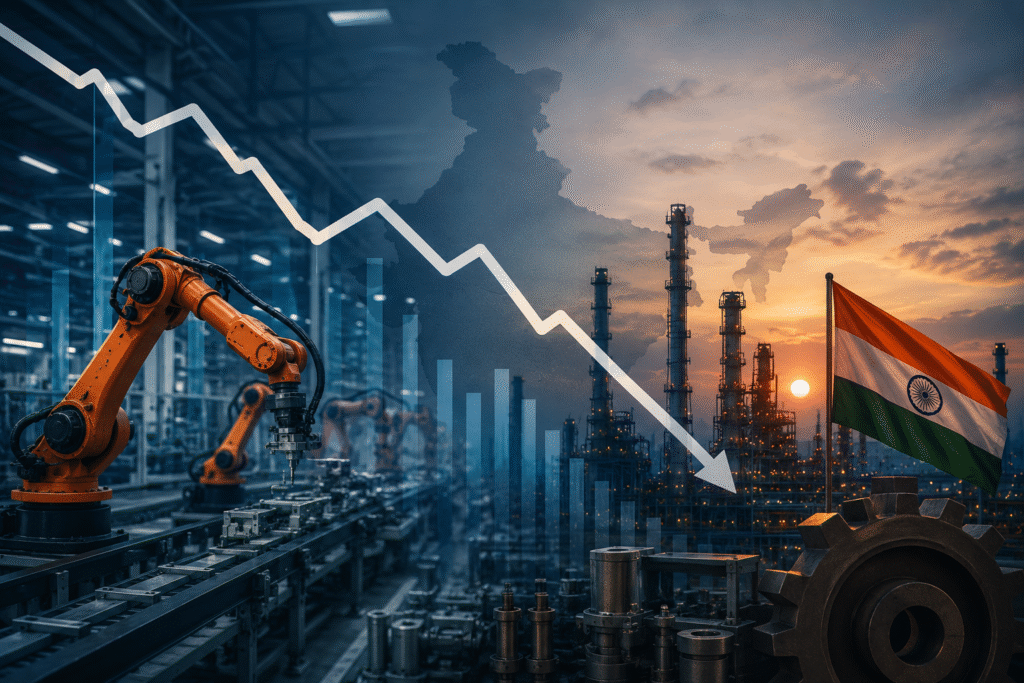
India’s manufacturing story is entering a more demanding phase.
The latest manufacturing PMI has fallen to its weakest level in nearly five years, pointing to softer demand and slower hiring across factories. It is an important signal, particularly after several years in which manufacturing has been one of the central pillars of India’s economic ambitions.
But one monthly indicator should not be mistaken for the entire picture.
Official industrial production data remains considerably stronger. Manufacturing output grew 7.8% year-on-year in June 2026, while overall industrial production grew 7.3%. Nineteen of 23 manufacturing industry groups recorded growth during the month.
So, is India’s manufacturing momentum weakening?
Perhaps at the margin. But the more important question is whether this is a temporary moderation in activity or the beginning of a more structural challenge.
India has already built considerable manufacturing momentum
Over the past few years, India’s manufacturing ambitions have moved well beyond the traditional objective of producing more for the domestic market.
Electronics, automobiles, pharmaceuticals, defence, renewable energy, capital goods and other sectors have attracted significant investment as companies and policymakers have sought to deepen domestic capabilities and integrate India more closely with global supply chains.
That progress matters because manufacturing has an effect far beyond factory output. It creates demand for logistics, engineering, technology, finance, infrastructure and skilled employment. A stronger manufacturing ecosystem can therefore create a much wider economic multiplier.
But building capacity is only the beginning.
The real test is whether that capacity can remain productive and competitive over the long term.
The next challenge is competitiveness
India has a large domestic market, and that provides an important foundation for manufacturing growth. But if India wants to become a major manufacturing power, domestic demand cannot be the only measure of success.
The bigger opportunity is to become a reliable part of global supply chains.
That means competing with established manufacturing economies on more than labour costs. Productivity, logistics, energy availability, technology adoption, quality, skilled talent and the strength of local supplier networks will increasingly determine where global companies invest and where they place orders.
This becomes even more important as global supply chains are being redesigned.
Geopolitical tensions, trade restrictions and concentration risks are encouraging companies to diversify production across markets. India has an opportunity to capture a meaningful share of this shift, but it is not competing in isolation. Vietnam, Mexico, Indonesia and other economies are also positioning themselves as an alternative to China for the same investment.
The opportunity is significant. So is the competition.
The question is no longer whether India can manufacture
For me, the more interesting question is what India will manufacture, how efficiently it will manufacture it, and whether Indian companies can compete globally while doing so.
That requires a different mindset.
Manufacturing investment has to be accompanied by investment in technology, automation, workforce capability, research and development and supply-chain depth. It also requires businesses to think beyond the immediate demand cycle.
A factory built today may operate for decades. The technology, processes and skills supporting that factory therefore need to be designed with a much longer horizon in mind.
This is where business strategy becomes particularly important.
A period of softer demand can make companies cautious. But long-term competitiveness is often built precisely during periods when the market is less certain. The companies that continue investing selectively in productivity, technology and capability can emerge stronger when demand accelerates again.
What should business leaders be watching?
The recent PMI number is worth watching, but I would not view it in isolation.
The more useful indicators are whether new orders recover, whether employment begins to strengthen, whether capacity utilisation continues to improve and whether Indian manufacturers are gaining ground in export markets.
We should also watch where capital is flowing.
If investment continues moving towards higher-value manufacturing, advanced technology and deeper domestic supply chains, that would suggest that the underlying structural story remains intact even if short-term activity moderates.
That is ultimately what will determine whether India’s manufacturing ambition becomes sustainable.
A pause can be healthy if it leads to better growth
India does not need to manufacture everything. It needs to become exceptionally good at manufacturing the products and components that matter to its own economy and to the global economy.
The latest numbers therefore look less like a reason for pessimism and more like a reminder that manufacturing growth cannot be measured by capacity additions alone.
The first phase was about building capacity.
The next phase has to be about building competitiveness.
If India can combine scale with productivity, technology, reliable infrastructure and globally integrated supply chains, a temporary moderation in manufacturing activity will matter far less than the capabilities being built underneath it.
That is the real opportunity.
India’s manufacturing story is not over. The standard by which we measure its success is simply becoming higher.

Pingback: India's Rising Role in Global Supply Chains
Pingback: Rupee Near ₹96: Should Indian CEOs Rethink 2026 Plans?
Pingback: China's Demand Push: What It Means for Indian Manufacturers