
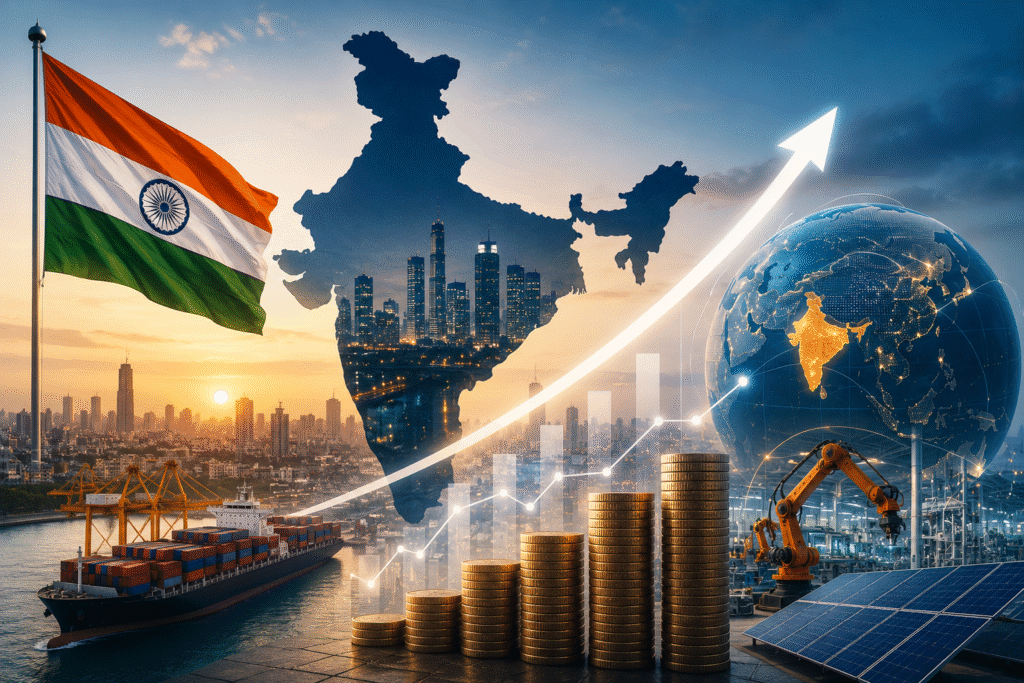
India’s $5 trillion economy ambition has been around for several years. What has changed is the timeline and, more importantly, the economic environment in which India now has to achieve it.
The latest projections put India on track to reach the $5 trillion mark around FY2028-29, with the delay from earlier expectations reflecting factors including rupee depreciation and changes in the global economic environment.
I don’t think the interesting question anymore is whether India can cross a particular dollar figure. The more important question is what kind of economy India builds on the way there.
India’s latest official numbers provide a strong starting point. Real GDP is estimated to have grown 7.7% in FY2025-26, with nominal GDP reaching approximately ₹346.36 lakh crore. The IMF currently projects real growth of 6.4% for 2026, even against a global environment marked by geopolitical tensions and higher energy risks.
Those are encouraging numbers. But sustaining that growth over several years is a different challenge.
Growth cannot come from one engine
A $5 trillion economy cannot be built on consumption alone, nor can it be built by relying primarily on government spending.
India needs several engines working together: private investment, manufacturing, exports, infrastructure, services, technology, entrepreneurship and rising household consumption.
The opportunity is particularly large in manufacturing and exports.
Global companies are reconsidering how and where they manufacture. Supply chains are being diversified because of geopolitical tensions, trade restrictions and concentration risks. India has the scale, talent and domestic market to become a much larger part of these global networks.
But having the opportunity is not the same as capturing it.
Indian companies will have to compete with manufacturing ecosystems across Asia and beyond on productivity, quality, logistics, technology and cost. Government incentives can accelerate investment, but ultimately it is the competitiveness of Indian businesses that will determine how much global production comes to India and stays here.
The real multiplier is productivity
This may be the most important part of the $5 trillion conversation.
India’s population and domestic market give it enormous economic scale. But the next stage of growth will depend increasingly on how much value each worker, factory, machine and unit of capital can generate.
Technology can play a major role here.
India has already built one of the world’s largest digital public infrastructure ecosystems. The next opportunity is to translate that digital capability into productivity across manufacturing, agriculture, financial services, healthcare, logistics and small businesses.
The same applies to artificial intelligence. Its economic significance will not ultimately be measured by the number of AI models India develops, but by how effectively Indian businesses use AI to improve productivity, create new products and compete globally.
Capital has to follow ambition
There is another part of the equation that deserves more attention: capital allocation.
India will require enormous amounts of productive investment to sustain high growth. That means domestic savings need to move efficiently into businesses, infrastructure and technologies capable of generating long-term returns.
The government’s role is important in creating infrastructure and improving the policy environment, but private capital has to increasingly take the lead in creating productive capacity.
This is where Indian businesses have an important responsibility.
The goal should not simply be to become larger companies. It should be to build companies that are more productive, more innovative and more globally competitive.
States and cities will matter as much as Delhi
India’s next phase of growth will also be increasingly regional.
Manufacturing clusters, logistics corridors, technology centres, financial hubs and emerging cities will determine how broadly economic opportunity spreads.
The $5 trillion target cannot be achieved by a handful of metropolitan economies carrying the country.
It will require states competing to attract investment, cities improving infrastructure and businesses finding talent and opportunity beyond the traditional economic centres.
That is already beginning to happen, and it could become one of India’s biggest advantages over the next decade.
The bigger target is not $5 trillion
A $5 trillion economy is a useful milestone. It gives policymakers, investors and businesses a tangible measure of scale.
But GDP is ultimately an output measure.
The more meaningful question is what sits underneath that number: how many productive jobs are created, how much private investment is generated, how competitive Indian companies become, how much India exports, how productive its workforce becomes and how resilient the economy is when the next global shock arrives.
India’s latest growth numbers show that the economy has considerable momentum. The IMF’s current outlook also keeps India among the world’s faster-growing major economies.
But sustaining that momentum will require more than maintaining a high headline growth rate.
The $5 trillion milestone will tell us how large India’s economy has become. The quality of the growth will tell us how powerful it has become.
And that, in my view, is the more important ambition.

Pingback: India's Rising Role in Global Supply Chains
Pingback: India’s Services Sector Driving Growth Amid Global Slowdown
Pingback: India's Closing Auction Session (CAS) Explained for Investors