
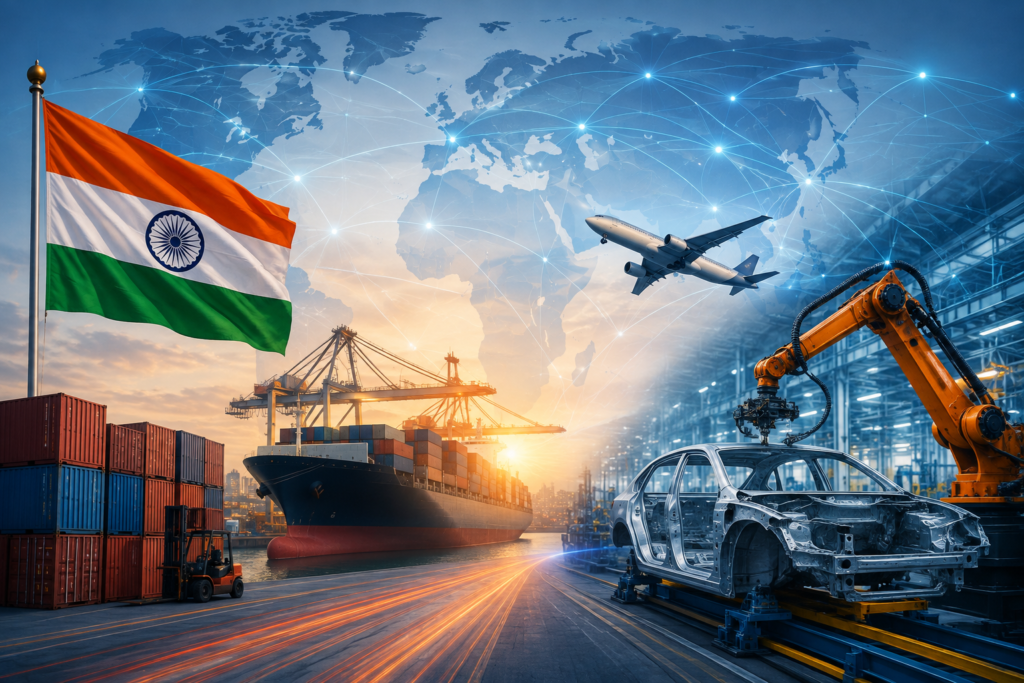
For decades, companies designed supply chains around one primary question: Where can we produce most efficiently?
That calculation is changing.
Geopolitical tensions, export restrictions, tariffs, critical-mineral dependencies and disruptions to major trade routes are forcing businesses to consider another question: Can we still depend on this supply chain when the world changes suddenly?
This is creating a significant opportunity for India.
The shift is visible across strategic industries. The International Energy Agency has highlighted growing concerns around the concentration of critical-mineral supply chains and the increasing use of trade restrictions. Its latest analysis argues that diversification and supply security have moved firmly onto the economic and national-security agenda.
For India, this is more than a geopolitical development. It is an industrial opportunity.
The world is moving from efficiency to resilience
The old globalisation model was built around concentration. If one country could manufacture something cheaper and at enormous scale, companies had a strong incentive to build their supply chains around it.
That model delivered tremendous efficiency.
It also created dependencies.
Today, companies are increasingly looking at multi-country sourcing, alternative manufacturing locations and greater control over critical inputs. The “China + 1” approach is evolving into something broader: companies are building multiple nodes across their supply chains rather than relying excessively on a single geography.
This does not mean China is disappearing from global manufacturing. It is far from it.
It means the definition of an efficient supply chain is changing. Reliability has acquired a price.
And India has a chance to compete on that new definition.
India has already shown that it can capture global manufacturing
The electronics industry offers one of the clearest examples.
India has moved rapidly from assembling finished electronics towards building a broader manufacturing ecosystem. Government data shows that cumulative electronics production has crossed ₹11.62 lakh crore, while electronics exports have exceeded ₹6.53 lakh crore under the large-scale electronics manufacturing PLI programme, as of March 2026.
The next objective is even more ambitious. The government is targeting $150 billion in electronics exports by 2030, while the Electronics Components Manufacturing Scheme has received a substantially larger outlay to deepen domestic component manufacturing.
That progression is important.
The real opportunity is not simply to become the place where products are assembled. It is to build the components, suppliers, engineering capabilities, technologies and talent that sit underneath those products.
That is where economic value begins to compound.
But geopolitics alone will not bring factories to India
This is where I would be cautious about the “China + 1” narrative.
Companies may want to diversify, but they will not move production simply because India is politically attractive.
They will move when the economics work.
That means infrastructure, logistics, reliable power, skilled labour, supplier depth, regulatory predictability, speed of execution and access to export markets all matter.
India has made significant progress, but the competition is intense.
Vietnam has built deep electronics capabilities. Mexico benefits from proximity to the US market. Indonesia is positioning itself around resources and industrial processing. Other economies are also trying to capture the same reconfiguration of global supply chains.
India’s advantage is its combination of scale, talent, domestic demand and an increasingly sophisticated industrial base.
The challenge is converting those advantages into consistently competitive manufacturing.
The next opportunity is deeper than assembly
This is perhaps the most important part of India’s opportunity.
If global companies are diversifying their supply chains, India should aim to capture more than the final manufacturing stage.
Consider what happens when a smartphone, electric vehicle or advanced industrial product is manufactured in India.
- Where do the chips come from?
- Where are the components made?
- Where are the materials processed?
- Where is the specialised machinery produced?
- Where does the engineering happen?
- Where is the intellectual property created?
The deeper India moves into these layers, the greater the economic value it captures.
This is why critical minerals, semiconductors, electronics components, advanced manufacturing and industrial technology matter so much. They are not isolated sectors. They are the foundations of the next generation of supply chains.
The IEA’s latest assessment makes this increasingly clear: supply concentration in critical minerals is becoming a strategic vulnerability for advanced manufacturing, clean energy and technology.
India’s window will not remain open forever
The opportunity created by geopolitical fragmentation is real, but it is also time-sensitive.
Companies making long-term supply-chain decisions are not going to wait indefinitely for ecosystems to mature. Countries that can provide scale, reliability and competitive economics will attract the next wave of investment.
India therefore has an opportunity to move from being an alternative manufacturing destination to becoming a strategic manufacturing partner.
That requires thinking beyond incentives and individual factories.
It requires building ecosystems.
It requires Indian companies to invest alongside global companies, develop domestic suppliers, build technology capabilities and compete for global customers.
It also requires continued policy consistency. The recent push to deepen electronics manufacturing, attract investment and improve export competitiveness is directionally important.
The real prize is not “China + 1”
India should aim higher than becoming someone’s second manufacturing location.
The real opportunity is to become a country that global companies cannot afford to leave out of their supply-chain strategy.
That happens when India is competitive not because the world needs an alternative, but because Indian manufacturing, technology and industrial capabilities are genuinely among the best available.
Geopolitics has opened the door.
India’s execution will determine how far it can walk through it.

Pingback: India’s $5 Trillion Economy by FY29: What Will Drive Growth?
Pingback: Can India Replace China as the World’s Factory?
Pingback: Rupee Near ₹96: Should Indian CEOs Rethink 2026 Plans?
Pingback: India Semiconductor Ecosystem: $12B Semicon 2.0 Proposals