
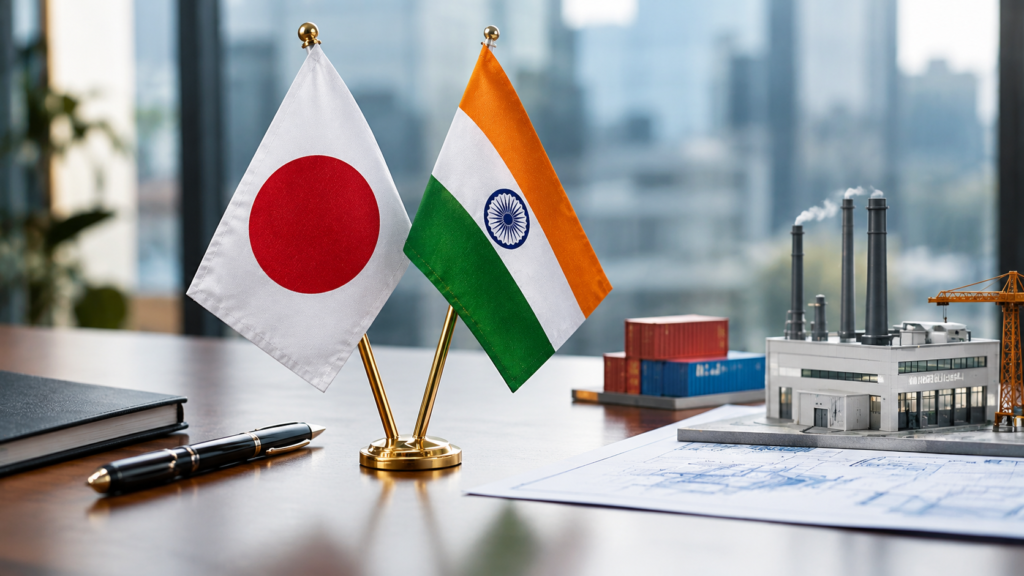
When a country invests billions in another economy, the obvious question is what is attracting that money. But I think there is another question worth asking: what does the investor see in that market that others might be overlooking?
Japan’s $5.71 billion investment in India during April–June 2026 gives us an interesting reason to explore this. Japan emerged as India’s largest source of FDI equity inflows during the quarter, accounting for nearly 29% of the total $19.81 billion received.
The number is certainly encouraging. However, I would not look at it in isolation. What interests me more is the changing relationship between the two countries and how it could influence India’s manufacturing ambitions over the next decade.
Japan’s Growing Confidence in the Indian Market
There is an important detail behind these investment figures. MUFG Bank’s acquisition of a 20% stake in Shriram Finance for approximately $4.4 billion contributed substantially to Japan’s latest FDI numbers.
This tells us that Japanese interest in India is no longer limited to automobiles, engineering and industrial production. Financial services are also becoming an important part of the relationship.
In my opinion, this is a healthy development. An economy that attracts investment across different sectors has more opportunities to build lasting business relationships. It also reflects the growing interest of international companies in India’s domestic market and its long-term growth prospects.
Japan has been an important economic partner for India for decades. What we are seeing now is an expansion of that relationship into newer areas.
Manufacturing Could Be the Biggest Beneficiary
India and Japan have something valuable to offer each other, and it goes beyond the size of their respective markets.
Japanese companies have spent decades developing manufacturing processes where quality, efficiency and precision are central to operations. India has a growing industrial workforce, engineering talent and a domestic market that continues to create demand.
Bringing these strengths together makes considerable business sense.
Take electric mobility, for example. India needs better battery technology, advanced components and efficient manufacturing systems as its automobile industry moves towards cleaner mobility. Japanese companies have considerable experience in these areas.
Semiconductors, electronics and industrial automation offer similar possibilities.
I believe the next step should be to encourage more collaboration between Indian and Japanese businesses at the supplier and technology-development levels. Setting up manufacturing facilities is important, but helping local companies develop the capabilities to meet international standards is equally valuable.
That is how investment can have a lasting impact on an economy.
There is More to This Partnership Than Investment
The two governments have also recognised the potential of a closer economic relationship. Under the India-Japan Joint Vision for the Next Decade announced in August 2025, Japan committed to facilitating JPY 10 trillion in private investment in India over ten years.
This is a significant commitment, but its success will depend on how effectively businesses on both sides turn it into actual projects.
India’s Japanese Industrial Townships have already provided Japanese companies with an established base to operate in the country. Going forward, I would like to see greater participation from Indian MSMEs in these manufacturing networks.
Smaller businesses often have the technical ability to become valuable suppliers, but they need access to technology, quality systems and long-term business relationships. Japanese partnerships can help create those opportunities.
There is also considerable scope for cooperation in renewable energy, research and development, and workforce training. These areas may not always generate immediate returns, but they can strengthen the industrial relationship over time.
A Positive Direction for Both Economies
Having followed India’s industrial development, I feel this is an encouraging phase in its relationship with Japan. The country is attracting interest not just because of its market size, but also because of the capabilities it is steadily developing.
There will naturally be challenges. Infrastructure, manufacturing costs, regulatory processes and the availability of specialised skills will continue to influence investment decisions. These are areas where consistent progress will matter.
But I remain optimistic about what the two countries can achieve.
Japan brings decades of industrial experience, while India brings a growing pool of talent, enterprise and ambition. There is a genuine opportunity to learn from each other and build businesses that are competitive well beyond their home markets.
I would see the success of this partnership not just in the investments announced today, but in the Indian companies that grow stronger, the technologies that emerge and the manufacturing capabilities that future generations inherit. That is a future worth working towards.
