
For most of my career, geopolitical risk was something businesses watched from a distance. It mattered, certainly, but unless you operated directly in a conflict zone or a politically unstable market, it rarely entered everyday operating decisions.
That is becoming harder to say today.
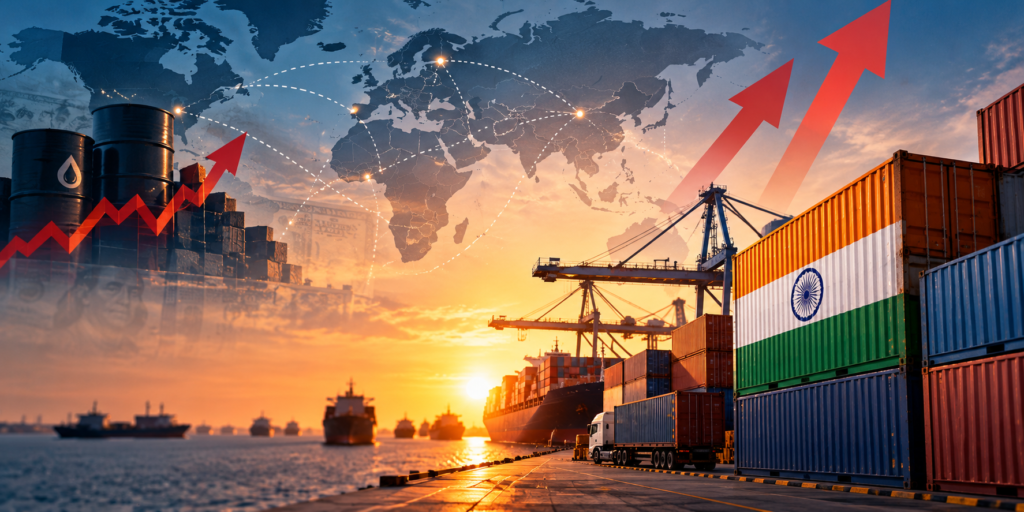
A conflict in the Middle East can change India’s energy bill. A disruption in the Strait of Hormuz can increase freight costs and delay shipments. A decision in Washington can alter tariffs on Indian exports. Export restrictions in China can affect the availability of minerals required for electronics, EVs and defence. A war thousands of kilometres away can suddenly change currencies, commodity prices and the economics of a supply contract.
Geopolitics has moved much closer to the balance sheet.
The question for India Inc is whether we are treating that as a temporary period of uncertainty or recognising it as a structural change in the cost of doing business.
The Cost Is Already Showing Up
Oil is perhaps the most obvious example.
Brent was still trading above $100 a barrel in mid-September as Middle East disruptions continued to affect global energy markets. For an economy as dependent on imported crude as India, sustained high prices do not remain an energy-sector problem for long. They work their way into transportation, manufacturing, chemicals, aviation, logistics, inflation and eventually consumer demand.
The currency adds another layer. The rupee has remained under pressure as expensive energy and global uncertainty weigh on markets, forcing the RBI to intervene to manage volatility.
Then there is shipping.
Recent disruptions around major energy routes have shown how quickly transportation itself can become a significant cost. This is not theoretical. India’s merchandise trade deficit widened sharply in June as shipping disruption through the Strait of Hormuz contributed to weaker exports and higher commodity costs.
And the risks do not stop with oil.
Semiconductors, rare earths, lithium, gallium, germanium and other critical inputs are increasingly becoming instruments of economic strategy. China still accounts for almost 99% of global gallium production and nearly 69% of germanium, two materials important to industries ranging from semiconductors to defence. Years after Chinese export restrictions began, alternative supply remains difficult and expensive to build.
When access to an input can change because of a diplomatic decision, procurement is no longer purely a commercial function.
The Cheapest Supply Chain May No Longer Be the Best Supply Chain
For decades, globalisation rewarded efficiency.
Companies concentrated manufacturing where costs were lowest. They reduced inventory. They built just-in-time supply chains. They sourced specialised components from whichever geography produced them most efficiently.
It worked remarkably well when the underlying assumption was that goods, capital and technology would continue moving relatively freely across borders.
That assumption is now much less reliable.
This does not mean companies should abandon efficiency and duplicate every supply chain. That would simply replace geopolitical risk with permanently higher costs.
But businesses may need to rethink what they mean by efficiency.
Imagine two suppliers. One is 5% cheaper but sits behind a politically vulnerable trade route, depends on a single source of raw materials and could become subject to export controls. The second costs slightly more but offers greater reliability and geographical diversification.
On a traditional procurement spreadsheet, the first supplier wins.
Once geopolitical risk is priced in, the answer may be very different.
That additional cost is essentially an insurance premium for continuity.
Indian companies increasingly need to decide how much that insurance is worth.
Indian Companies Are Already Responding
One of the clearest signs of this shift can be seen in outbound investment.
Indian companies have announced close to $24 billion in overseas acquisitions so far in 2026, putting outbound M&A on course for a record year. According to JPMorgan, one of the forces behind that activity is the desire to secure supply chains and strategic resources as geopolitical volatility increases.
This is an important change in mindset.
For years, overseas acquisitions by Indian companies were often discussed primarily in terms of market expansion. Increasingly, companies may also invest abroad because they need control over something strategically important.
An Indian critical-minerals company, for example, is currently exploring nickel mine acquisitions in Indonesia and the Philippines while developing lithium assets in Zimbabwe and processing capacity in India.
That is not simply international expansion. It is supply-chain architecture.
The same thinking can apply to energy, manufacturing inputs, technology, logistics and even talent.
Sometimes the best way to reduce dependence is not to find another supplier. It is to own part of the supply.
Self-Reliance Should Not Mean Isolation
India’s response to geopolitical risk also needs some nuance.
The government has identified roughly $51 billion of annual imports that could potentially be replaced through domestic manufacturing, covering areas including renewable energy, semiconductors, mobile phones and textiles.
Building domestic capability in strategically important sectors makes sense.
But complete self-sufficiency is neither realistic nor necessarily desirable.
No major economy manufactures everything it consumes. Modern products depend on extraordinarily complex international supply chains, and trying to reproduce every component domestically could make Indian industry less competitive rather than more secure.
The objective should therefore be resilience, not isolation.
India should manufacture more where it has competitive potential or where excessive dependence creates strategic risk. At the same time, it should build relationships with multiple international suppliers, secure overseas resources, expand recycling and maintain strategic inventories where necessary.
The same principle applies at the company level.
The goal is not to eliminate global dependence.
It is to eliminate dangerous dependence.
CEOs and CFOs Need a Different Risk Conversation
This is where I believe the biggest change needs to happen.
Geopolitical risk cannot remain a slide presented once a year at the board meeting.
It needs to enter capital allocation.
Before approving a major investment, companies should understand not only the expected return but also its exposure to currencies, commodities, sanctions, tariffs, shipping routes and concentrated suppliers.
Procurement teams should know which components have no realistic alternative supplier.
Finance teams should stress-test what happens if oil remains above $100, the rupee moves sharply, freight costs double or a major export market suddenly changes tariffs.
Boards should know which geopolitical event could stop production rather than merely reduce margins.
And companies should decide in advance what level of redundancy they are willing to pay for.
The answers will differ by industry. An IT services company faces a very different geopolitical exposure from an airline, steel producer, pharmaceutical manufacturer or electronics company.
But the underlying question is the same:
What happens to our business if the world does not behave the way our annual plan assumes it will?
Resilience Has a Cost. So Does Being Unprepared.
There is a temptation to see diversification, additional inventory, hedging and alternative suppliers purely as costs.
They are costs.
But so is shutting a factory because one component cannot arrive.
So is losing an export market because tariffs suddenly change.
So is being forced to purchase raw materials on the spot market during a crisis.
So is discovering that the cheapest supplier was only cheap while everything remained stable.
This is where the definition of good management may need to evolve.
For years, companies were rewarded for removing inefficiency from their systems. The next phase may require leaders to deliberately put a small amount of redundancy back in.
Not waste. Not unnecessary duplication.
Resilience.
The distinction matters.
Geopolitical Risk Is Becoming a Business Variable
Nobody can predict the next geopolitical crisis with confidence. That is precisely the point.
Businesses do not need to predict every event. They need to build organisations capable of absorbing events they did not predict.
India itself is increasingly pursuing that strategy through diversified energy relationships, new trade agreements, domestic manufacturing, critical-mineral partnerships and engagement with countries across competing geopolitical blocs.
Indian businesses should be thinking along similar lines.
Diversify where concentration creates vulnerability. Build domestic capability where it makes commercial and strategic sense. Secure critical inputs. Stress-test assumptions. Maintain financial flexibility. And avoid allowing short-term efficiency to create long-term dependence.
The world may indeed be becoming more expensive to do business in.
But the biggest cost may not be the additional price of resilience.
It may be discovering, when the next disruption arrives, that we never priced the risk at all.
